
What’s in This Article:
What Government Contractors Need to Know
DCMA vs. DCAA: The Key Differences
When do DCAA and DCMA Get Involved?
Can DCAA or DCMA Become Involved With Civilian Federal Agency Contracts?
How Government Contractors Can Prepare
The Bottom Line on DCMA vs. DCAA
What Government Contractors Need to Know
Government contracting comes with plenty of acronyms, and two that are easy to confuse are DCMA and DCAA. Both play important roles in federal contracting, but their responsibilities are different.
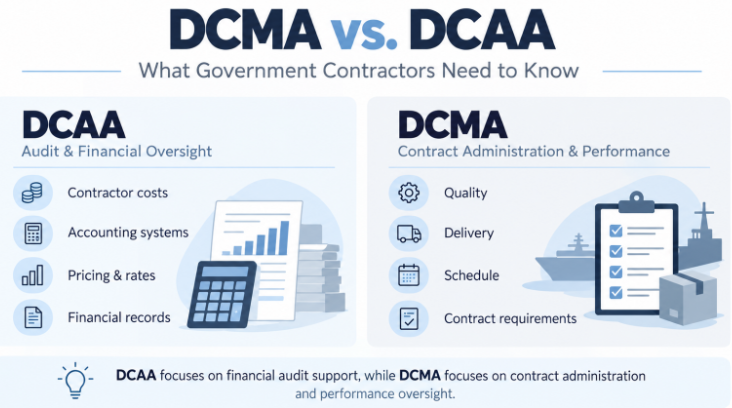
DCAA and DCMA serve different roles in federal contracting. DCAA primarily audits contractor costs, accounting systems, pricing, and other financial information, while DCMA primarily administers contracts and monitors performance. Both may also support contracts involving civilian federal agencies under applicable federal arrangements.
Knowing which agency does what can help contractors understand what may be reviewed and how to prepare.
What Does DCAA Do?
DCAA provides contract audit and financial advisory services to government agencies. Its work focuses on financial representations made by contractors and the records supporting proposed and incurred costs.
Common DCAA activities include pre-award accounting system surveys, contract price proposal audits, incurred cost audits, provisional billing rate reviews, progress payment reviews, and certain contractor business system audits.
For contractors, DCAA may look at whether the accounting system separates direct and indirect costs, labor is charged to the correct contracts, indirect rates are supported, and unallowable costs are identified when required.
DCAA provides its findings to contracting officers or other authorized government officials who request audit support when it is needed.
For more on accounting system readiness, see CJA’s
A Guide to DCAA-Compliant Accounting Systems for GovCon Firms.
What Does DCMA Do?
DCMA has a broader contract management role. It provides contract administration services and works with defense contractors from pre-award activities through contract performance and sustainment.
Depending on the contract and the functions assigned to DCMA, its responsibilities may include monitoring quality, delivery schedules, cost, contractor performance, government property, payments, and other contract requirements.
In plain English, DCMA is generally looking at whether the contractor is meeting the terms of the contract and whether the government is receiving what it agreed to purchase.
For example, DCAA may review whether a contractor’s indirect rates and labor charges are properly supported, while DCMA may be focused on whether the contractor is meeting delivery, quality, or other contract performance requirements.
DCMA vs. DCAA: The Key Differences
| DCAA | DCMA | |
| Primary role | Contract audit and financial advisory services | Contract administration and performance oversight |
| Primary focus | Costs, accounting systems, rates, pricing, and financial records | Quality, schedule, delivery, cost, and contract requirements |
| Typical involvement | Financial audits before and after award | Pre-award through contract performance and sustainment |
| Contractor interaction | Reviews financial representations and supporting records | Monitors assigned contract administration requirements |
The agencies can also work together. FAR Part 42 separates contract audit services from contract administration services, and audit information may support contract administration decisions.
When do DCAA and DCMA Get Involved?
There is no simple rule that assigns one contract type to DCAA and another to DCMA.
DCAA activity is often more visible on cost-reimbursement contracts because actual costs, indirect rates, billing, and incurred cost submissions require significant financial support. However, DCAA may also become involved with firm-fixed-price contracts when the government needs audit assistance with pricing proposals, progress payments, claims, or other financial matters.
DCMA contract administration is also not limited to a specific contract type. Its role depends on the contract and the functions delegated by the contracting officer.
So, a firm-fixed-price contract does not automatically eliminate DCAA involvement, and a cost-type contract does not mean a contractor will work only with DCAA.
Can DCAA or DCMA Become Involved With Civilian Federal Agency Contracts?
Yes, in certain circumstances. Although DCAA and DCMA are Department of Defense agencies, their services may also support contracts awarded by civilian federal agencies.
DCAA may provide audit services to non-DoD agencies through established federal arrangements, while contract administration or specialized support may be assigned to DCMA when authorized. This does not mean either agency automatically oversees civilian contracts; their involvement depends on the specific contract, agency arrangements, and requested or delegated responsibilities.
How Government Contractors Can Prepare
Preparation should begin before an agency requests information.
For contractors preparing for an accounting system review, CJA’s guide to common pre-award survey failures provides additional insight into readiness gaps that can create problems during a government review.
Contractors should maintain accounting records supporting cost classifications, labor charges, indirect rates, unallowable costs, billing, and job costs. They should also keep organized documentation for deliverables, subcontractor activity, government property, billing requirements, and other obligations specific to the award.
The Bottom Line on DCMA vs. DCAA
DCAA primarily focuses on contract audits and financial information. DCMA primarily focuses on contract administration and performance.
A contractor may interact with one agency or both. Understanding the distinction before a review begins makes it easier to organize records, respond to requests, and know what each agency is evaluating.
Need Help Preparing for DCAA or Other Government Reviews?
Cheryl Jefferson & Associates helps government contractors strengthen accounting systems, prepare for government reviews, evaluate cost classifications, and maintain FAR-aligned accounting practices.
Learn more about CJA’s GovCon Consulting services.
Frequently Asked Questions
What’s the difference between DCMA and DCAA?
DCAA primarily performs contract audits and evaluates financial and accounting information. DCMA primarily performs contract administration and monitors whether contractors are meeting applicable contract requirements.
Which agency audits which type of contract?
Neither agency is limited to one contract type. DCAA’s involvement depends on the financial audit support requested by the government, while DCMA’s involvement depends on the contract administration functions assigned to it.
Can DCAA audit a firm-fixed-price contract?
Yes. Contract type alone does not determine whether DCAA can become involved. DCAA may provide audit support for pricing proposals, progress payments, claims, or other financial matters when requested by the government.