
What’s in This Article:
General and Administrative expenses
What Is Included in G&A Expenses?
What’s the Difference Between G&A and Overhead?
Why Does G&A Matter for Government Contractors?
What Can Business Leaders Learn From G&A?
General and Administrative expenses
Every business has costs that keep the company running but cannot be traced neatly to one customer, project, or service. Executive management, accounting, legal support, company-wide software, and other administrative functions still have to be paid for, even though they may not directly produce a specific deliverable.
That is where G&A, or General and Administrative expenses, comes in.
G&A helps business leaders understand what it really costs to operate the company as a whole. For government contractors, it can also affect indirect rates, pricing, billing, and compliance.
G&A stands for General and Administrative expenses. These are costs associated with managing and supporting the business as a whole, rather than performing work for one specific customer, project, or department. Common examples may include executive management, accounting, human resources, legal support, insurance, and company-wide administrative technology.
What Does G&A Mean?
In accounting, G&A is an indirect cost category used to group expenses that support the organization as a whole. For government contractors, how those costs are classified and allocated is especially important because it can affect indirect rates, pricing, billing, and compliance.
Practically, G&A is more than an expense label. It is a way of organizing company-wide support costs so management can understand the resources required to run the business and, for government contractors, so those costs can be allocated consistently across the work they support.The Federal Acquisition Regulation defines G&A expenses as management, financial, and other expenses incurred for the general management and administration of the business unit as a whole.
For a deeper look at G&A rates and cost allocation for government contractors, see CJA’s
G&A Costs Explained: What They Are and How to Keep Them in Check.
What Is Included in G&A Expenses?
There is no single list of G&A expenses that applies perfectly to every company. The appropriate classification depends on how the business operates and who benefits from the cost.
Common examples may include:
- Executive and corporate management
- Accounting and finance
- Human resources
- Legal and professional services
- Company-wide insurance
- Corporate office expenses
- Administrative software and technology
- Other costs that support the organization as a whole
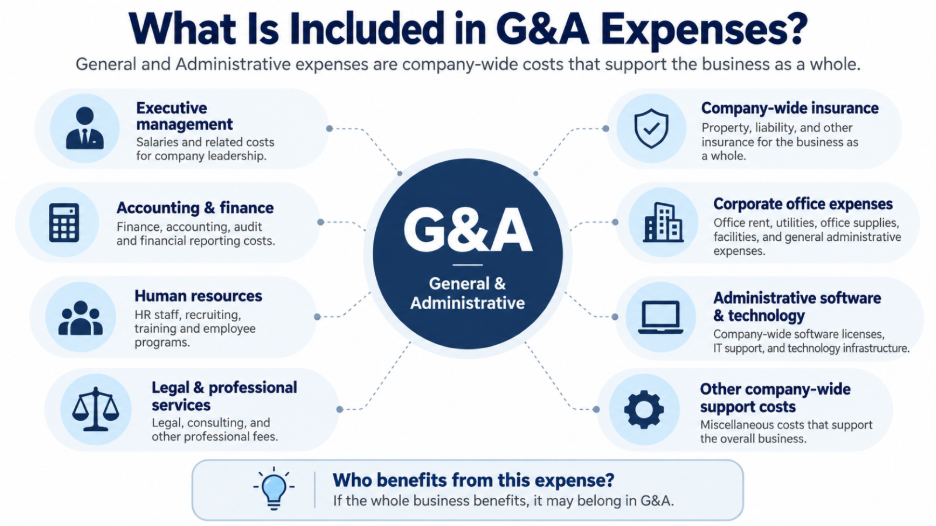
A useful question to ask is:
Who benefits from this expense?
If the entire business benefits, the cost may belong in G&A. If the cost supports a specific operating function, department, project, or contract, another classification may be more appropriate.
For example, company-wide accounting software may support the organization as a whole. Software used only by one engineering department may be more closely associated with that department’s overhead.
The classification should follow the purpose and benefit of the cost rather than simply the name of the account.
What’s the Difference Between G&A and Overhead?
G&A and overhead are both commonly considered indirect costs, but they are not necessarily the same thing.
A simple way to think about the difference is:
| G&A | Overhead | |
| Supports | The business as a whole | A specific operating function or group of activities |
| Examples | Corporate accounting, executive management, company-wide legal support | Department supervision, facilities, or tools supporting a specific function |
| Main question | Does the entire company benefit? | Does a particular function or group of work benefit? |
For example, executive management that oversees the entire company may be part of G&A. A supervisor supporting only one operational department may be more appropriately included in that department’s overhead pool.
That distinction matters because putting costs into the wrong pool can distort internal reporting and, for government contractors, affect indirect rates and proposal pricing.
For more on how indirect and direct costs fit together, see CJA’s
The Hidden Costs in Your Government Contracts, And How to Control Them.
Why Does G&A Matter for Government Contractors?
For many businesses, G&A helps management understand operating efficiency and the cost of running the organization.
For government contractors, G&A can also affect pricing, billing, cost allocation, indirect rates, and compliance.
FAR 31.203 requires indirect costs to be grouped logically and allocated using a base that reflects the relationship between the costs and the work that benefits from them.
For contractors subject to Cost Accounting Standard 410, G&A expenses are generally grouped separately and allocated to final cost objectives using an appropriate cost input base.
The important point is that a G&A rate is not just a percentage sitting on a report. It reflects two things:
- Which costs are included in the G&A pool.
- Which allocation base is used to spread those costs across the business.
That is why simply asking whether a G&A rate is “high” or “low” does not tell the whole story. The rate has to be evaluated in the context of the contractor’s cost structure and allocation methodology.
How Is a G&A Rate Calculated?
At a basic level:
G&A Rate = G&A Expense Pool ÷ G&A Allocation Base
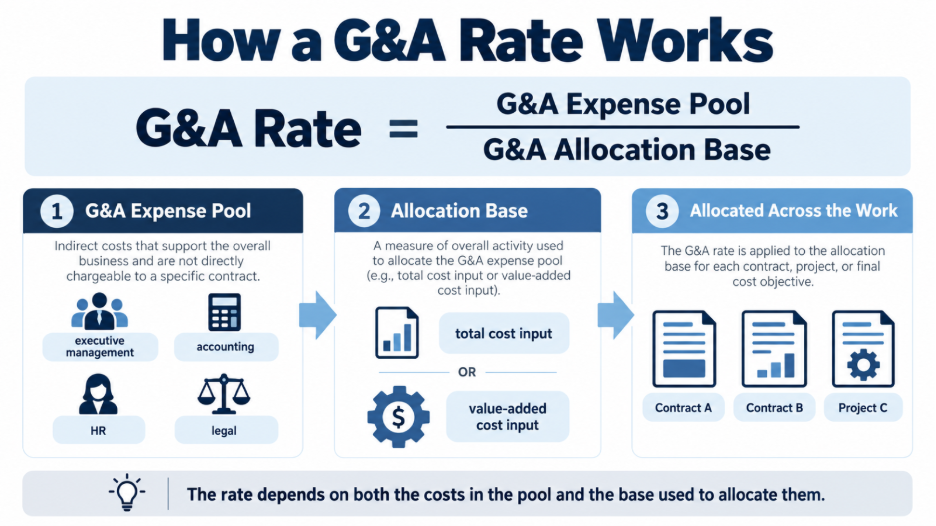
The G&A expense pool is the group of costs classified as General and Administrative expenses.
The allocation base is the measure used to distribute those expenses across the appropriate work.
Depending on the contractor’s circumstances and applicable requirements, the base may include total cost input, value-added cost input, or another appropriate method.
This is why two businesses with similar G&A expenses can have very different G&A rates. Their labor mix, subcontracting activity, materials, operating structure, and allocation bases may be different.
What Can Business Leaders Learn From G&A?
G&A is not only a compliance calculation.
It can also help leadership understand how much infrastructure the company requires to operate and whether administrative costs are growing appropriately as the business expands.
Useful questions may include:
- Are administrative costs increasing faster than revenue?
- Are new systems or personnel improving efficiency?
- Are cost classifications still appropriate as the company grows?
- Is a change in the cost structure affecting margins or pricing?
- Are indirect rates moving in a way management did not expect?
For government contractors, regular review can also help identify misclassified costs or unexpected rate changes before they affect proposals, billing, or incurred-cost reporting.
The Bottom Line on G&A
G&A represents the costs associated with managing and supporting the business as a whole.
The concept is straightforward, but the classification matters. The same type of expense may be treated differently depending on who benefits from it and how the company operates.
For government contractors, G&A affects more than internal reporting. It can influence indirect rates, pricing, billing, and compliance, which makes a consistent and well-supported cost structure especially important.
Frequently Asked Questions
What is G&A in business?
G&A stands for General and Administrative expenses. These are costs associated with managing and supporting the business as a whole rather than performing work for one specific customer, project, or department.
What is included in G&A expenses?
G&A may include company-wide management, accounting, finance, HR, legal, insurance, corporate technology, and other administrative expenses. The appropriate classification depends on how the cost benefits the business.
What’s the difference between G&A and overhead?
G&A generally supports the business as a whole, while overhead generally supports a specific operating function or group of activities. Both may be indirect costs, but they serve different purposes within the cost structure.
What is a G&A rate?
A G&A rate is the percentage used to allocate General and Administrative expenses across the appropriate cost base. At a basic level, it is calculated by dividing the G&A expense pool by the applicable allocation base.
Is there a good G&A rate?
There is no universal G&A rate that is appropriate for every business. A meaningful rate depends on the company’s size, industry, cost structure, allocation base, and how it performs its work.
Need Help With G&A or Indirect Rates?
Cheryl Jefferson & Associates helps government contractors establish defensible indirect cost structures, evaluate cost classifications, monitor rates, and maintain accounting practices aligned with federal requirements.