What’s in This Article:
Understanding Accounts Payable Turnover
Importance of Calculating Accounts Payable Turnover
Calculating this Ratio and the Associated Precautions
Take Control of Your Accounts Payable
Frequently Asked Questions
Understanding Accounts Payable Turnover
One of the key concerns that management often has is their payment obligation to the suppliers of their core services. For a service industry business, this is typically their subcontractors or consultants. This is encapsulated in a short-term liquidity measure, the accounts payable turnover ratio. It’s the ratio that measures the speed at which the company makes payments to their suppliers after obtaining the services on “credit”.
Importance of Calculating Accounts Payable Turnover
There are many things that a company can learn from changes to the accounts payable turnover. When this ratio is decreasing, owners of the company will know that their financial stability is reducing, and they may lose their key suppliers in the process.
If the turnover ratio is increasing at a fast rate, it means that the company is making payments to suppliers very quickly. Suppliers demanding quicker payments can cause this. It may also mean the company has received some incentives in the form of discounts on early payments.
It is also another way to detect any changes to the terms of payments to the subcontractors and consultants. When the company and its suppliers or subcontractors agree to change payment terms, the change will automatically affect the turnover ratio. The shift to the right or the left of the mean position would be a result of such implementations.
Calculating this Ratio and the Associated Precautions
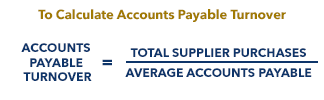
To calculate accounts payable turnover, we take the sum of all the accounts payable at the beginning and the end of the accounting period, and then you divide it by two.
Concerned companies should make sure that all the expenses incurred in the acquisition of the services from the suppliers are factored in. In addition, utility bills, employee expense reports, rent etc. should be removed from the accounts payable balance before performing this calculation. This helps to eradicate the possibilities of arriving at a very erroneous and inaccurate turnover ratio.
The person charged with the responsibility of dealing with the suppliers’ payment use this formula to calculate this ratio to ensure that the company’s finances are stable.
There are numerous benefits that a company would enjoy after calculating this ratio more often. The company could determine a benchmark accounts payable turnover at which is suppliers are satisfied and the company maintains adequate cash flow for smooth operations.
Again, this ratio would help the company during self-evaluation to establish whether they are meeting their annual goals and objectives. One of the major strengths of a company is paying their debts on time to improve their credit worthiness, but a company should not pay too earlier at the detriment of maintaining sufficient cash for other needs.
Take Control of Your Accounts Payable
Managing accounts payable effectively can improve cash flow, strengthen vendor relationships, and provide better visibility into your financial position. CJA can help you build accounting processes that support smarter financial decisions and sustainable growth.
Ready to strengthen your accounting processes? Contact CJA to learn how we can help.

Frequently Asked Questions
1. What is accounts payable turnover?
It measures how quickly a business pays its suppliers and vendors.
2. How is accounts payable turnover calculated?
Divide supplier purchases by average accounts payable.
3. Is a higher accounts payable turnover always better?
No. Paying too quickly can reduce available cash, while paying too slowly may signal cash-flow issues or strain supplier relationships.