
What’s in This Article:
Accounts Receivable and Invoices
One of the things that you will need to do for your business at the end of the year is to close the books. If you have kept up with your accounting throughout the preceding months, this shouldn’t be too difficult to accomplish. However, there are still some extra things that need to be done at year-end.
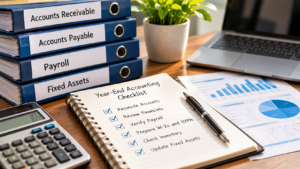
We’ve put together an end of the year accounting checklist to help keep your business on track and prepare for the coming year.
Get Organized
If you haven’t been using an accounting system to organize your financial records, this may be a good time to start. Keeping receipts, invoices, bank statements, and other supporting documentation organized throughout the year makes the year-end closing process much easier.
Review your accounting records to make sure transactions have been recorded accurately and supporting documents are available when needed. Electronic recordkeeping can also help reduce misplaced documents and make financial information easier to access.
The IRS recordkeeping guidance explains the importance of maintaining records that support business income and expenses.
Reconcile Bank Accounts
Reconcile your bank accounts to make sure that the transactions recorded in your accounting system match your bank and credit card statements.
If they don’t match, determine where the differences occurred and look for missing transactions, duplicates, outstanding checks, or other errors. Unresolved differences can affect the accuracy of your financial statements.
Accounting software can assist with reconciliation, but the balances and outstanding items still need to be reviewed.
Profit & Loss Statements
Review your business’s profit and loss statements to ensure that everything makes sense and that income and expenses are categorized properly.
Many accounting programs can help categorize transactions, but those classifications should still be reviewed for accuracy.
One way to identify potential issues is to compare your current year’s profit and loss statement with the previous year’s results. Significant changes should be investigated to determine whether they reflect actual business activity or accounting errors.
Also consider comparing actual results with your budget or forecast to better understand your business’s financial performance.
Accounts Payable and Expenses
Confirm that business expenses and outstanding bills have been properly recorded in your accounting system.
There are many business expenses, such as cell phone and internet costs, that may qualify as deductible business expenses when they meet applicable tax requirements. Gather supporting documentation for your tax accountant.
Review accounts payable to ensure that bills have been entered correctly, payments have been applied, and outstanding balances are accurate.
Remember that an unpaid bill may still need to be recorded at year-end, depending on your accounting method. Not every bill must be paid before December 31.
Notes Payable
If your business has outstanding loans, confirm that the balances recorded in your accounting system agree with lender statements and other supporting documents.
Investigate discrepancies and make any necessary corrections.
Also confirm that loans paid off during the year have been removed from outstanding liabilities and that new loans have been properly recorded.
Review interest expenses and ensure that loan payments have been correctly divided between principal and interest.
Accounts Receivable and Invoices
Have you sent out all invoices for work completed or amounts otherwise billable during the year?
Review outstanding receivables to confirm that invoices, payments, credits, and balances are recorded accurately.
It is also important to examine past-due receivables and determine whether additional collection efforts are appropriate.
If an amount appears uncollectible, discuss the appropriate accounting treatment with your accountant. A financial statement write-off does not automatically qualify as a tax deduction, and outstanding invoices do not necessarily need to be collected before year-end.
Fill Out W-2s and 1099s
The IRS requires businesses to report employee wages through Form W-2 and certain payments to nonemployees through the appropriate Form 1099.
For payments made during 2026, the general Form 1099-NEC reporting threshold for qualifying nonemployee compensation increased from $600 to $2,000. Other reporting rules and exceptions may apply.
Employers generally must furnish W-2 forms to employees and file them with the Social Security Administration by January 31 of the following year, adjusted when the deadline falls on a weekend or legal holiday.
Form 1099-NEC generally must also be furnished to recipients and filed with the IRS by the applicable January 31 deadline. Other types of 1099 forms may have different deadlines.
Review employee and vendor information, including names, addresses, and taxpayer identification numbers, before preparing these forms.
See the IRS information return requirements for additional guidance.
Take Physical Inventory
If inventory applies to your business, you’ll want to review or count your year-end inventory so that the recorded balances can be reconciled with your accounting records.
Investigate discrepancies, damaged or obsolete items, and inventory that may have been incorrectly recorded.
Inventory records are also important for determining cost of goods sold and preparing accurate financial statements.
The appropriate inventory valuation and reporting methods depend on the business and applicable accounting and tax rules.
Fixed Assets
Review the fixed assets listed on your balance sheet.
If any assets have been sold, retired, or otherwise disposed of during the year, make sure those changes are reflected in your accounting records.
Also review new asset purchases, confirm that qualifying expenditures have been properly classified, and verify depreciation calculations.
Certain purchases may qualify for immediate deductions or accelerated depreciation under applicable tax rules, so review the treatment with your tax professional.
This is a critical step in your year-end accounting checklist.
Payroll
Make sure that payroll expenses and related tax liabilities recorded throughout the year agree with your payroll reports and supporting documentation.
If you use a third-party payroll provider, reconcile the provider’s year-end reports to your accounting system.
Review employee compensation, payroll tax payments, benefits, and outstanding payroll liabilities to identify discrepancies before preparing annual reporting forms.
Year-end payroll reconciliation can help prevent errors in W-2 reporting and financial statements.
This end of the year accounting checklist is meant to give you a general idea of the items to take care of as December 31 approaches. The specific adjustments required will depend on your business, accounting method, and reporting requirements.
At Cheryl Jefferson & Associates, we help small businesses maintain accurate accounting records and gain better financial visibility throughout the year. Our Subscription Services provide ongoing accounting and financial reporting support.
Contact CJA to discuss your business’s accounting and financial reporting needs.
Frequently Asked Questions
When should a business start preparing for year-end accounting?
Ideally, businesses should maintain accurate records and reconcile accounts throughout the year. Starting the year-end review before December 31 can help identify issues early.
What financial statements should be reviewed at year-end?
Businesses should generally review their balance sheet, profit and loss statement, and relevant supporting schedules. Cash flow reporting may also help assess financial performance.
Why is reconciling accounts important before closing the books?
Reconciliation helps identify missing transactions, duplicates, incorrect balances, and other discrepancies that could affect financial statements and tax reporting.