
What’s in This Article:
What does a P&L statement include?
How is a P&L different from a balance sheet?
How to get more value from your P&L
What a P&L Statement Actually Looks Like
If you have ever opened a Profit and Loss statement and immediately looked for the bottom-line number, you are definitely not alone.
A P&L can look intimidating at first, but the basic idea is actually pretty simple. It shows the revenue a business earned, the expenses it incurred, and whether the business generated a profit or loss over a specific period of time.
If revenue is growing but profit is not, margins are changing, or cash still feels tighter than expected, the P&L is often one of the first places to start asking why.
A Profit and Loss statement, also called a P&L or income statement, summarizes a company’s revenue and expenses over a period of time and shows the resulting profit or loss.
Below, we will walk through what a P&L statement includes, look at an example of a P&L, and explain what the numbers can and cannot tell you about your business.
What Is a P&L Statement?
A Profit and Loss statement reports the financial performance of a business over a specific period, such as one month, one quarter, or one year.
You may also hear it called an income statement. In most everyday business conversations, the terms P&L and income statement are used interchangeably.
Unlike a balance sheet, which shows where the company stands at a particular date, the P&L covers activity that happened during a period of time.
For example:
Profit & Loss
January 1 through March 31, 2026 would show revenue and expenses for that three-month period.
The U.S. Securities and Exchange Commission also describes an income statement as one of the primary financial statements and explains that it reports revenue, expenses, and the resulting net income or loss for a specific period.
See the SEC’s guide to understanding an income statement
What Does a P&L Statement Include?
At its simplest, a P&L follows this basic idea:
Revenue – Expenses = Profit or Loss
Real P&Ls normally contain more detail than that, but most include some version of the following sections:
Revenue
Money earned from the company’s normal business activities.
Direct Costs or Cost of Revenue
Costs directly associated with delivering the product or service. Depending on the type of business and its accounting structure, this might include direct labor, subcontractors, materials, or other costs associated with performing the work.
Gross Profit
Revenue remaining after direct costs are deducted.
Operating Expenses
Costs of operating the business that are not directly tied to delivering one particular product or service. Examples may include administrative payroll, rent, insurance, accounting, software, and other overhead or administrative expenses.
Operating Income
What remains after operating expenses are deducted from gross profit.
Other Income and Expenses
Items outside normal operations, such as interest income or interest expense, depending on the company’s reporting format.
Net Income or Net Loss
The final result after the applicable revenue and expenses are included. This is the number people are usually referring to when they talk about the bottom line.
Example of a P&L Statement
Here is a simplified example of what a P&L might look like for a service-based business.
The numbers are illustrative, but the format is similar to what a business owner might see in an accounting system.
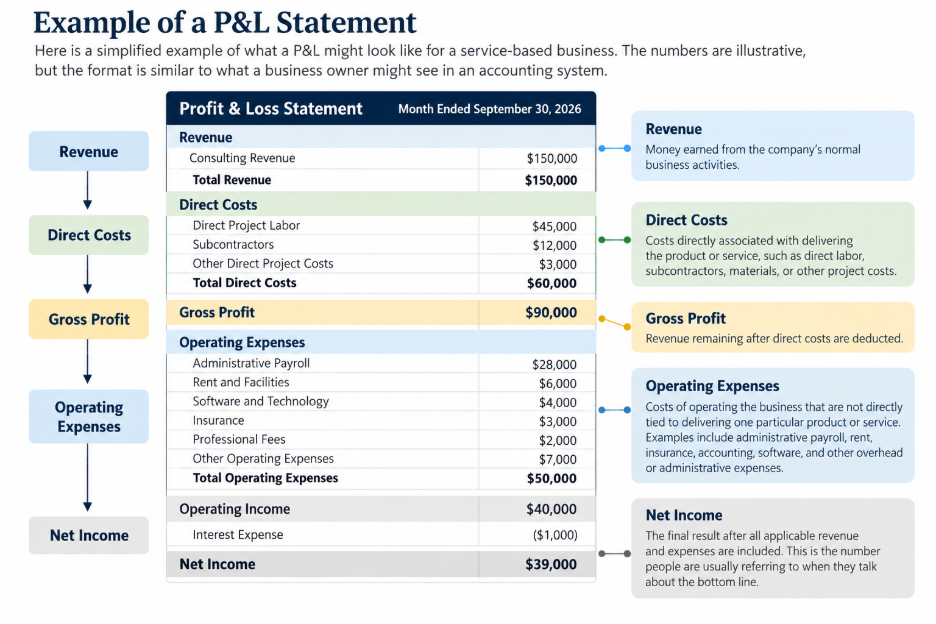
So what does this example of a P&L actually tell us?
The company generated $150,000 in revenue during the month.
It incurred $60,000 of direct costs to perform the work, leaving $90,000 in gross profit.
After another $50,000 of operating expenses and $1,000 of interest expense, the company finished the month with $39,000 of net income.
That gives us the result. The more interesting questions come next.
How Do You Read a P&L?
One mistake is looking only at whether net income is positive.
Yes, profit matters. But the movement between the top and bottom of the statement often tells you more.
Take the example above. The business earned $39,000. Great.
But what if last month it earned $45,000 on only $140,000 of revenue?
Revenue went up, but profit went down.
Now we have something worth investigating.
Maybe direct labor increased. Maybe subcontractor costs were unusually high. Maybe software or overhead expenses jumped. Maybe the company took on more work but priced that work at a lower margin.
This is why a useful P&L review usually involves comparing the report to something else:
- A prior month or quarter
- The same period last year
- A budget or forecast
- Expected gross or operating margins
- Other financial and operational KPIs
A P&L gives you the numbers. Comparisons give those numbers context.
For more on the difference between having accurate financial reports and actually using them to make better decisions, see CJA’s
Why Most Businesses Have Good Bookkeeping but Still Make Bad Financial Decisions.
How Is a P&L Different From a Balance Sheet?
The easiest distinction is period of time versus point in time.
The reports work together, but they answer different questions.
Your P&L may show that the company had a very profitable month.
Your balance sheet could simultaneously show a large accounts receivable balance, significant debt, or other issues affecting the company’s financial position.
That is one reason it is risky to judge the health of a business from the P&L alone.
What a P&L Does Not Tell You
A profitable P&L does not necessarily mean there is plenty of cash sitting in the bank.
That surprises a lot of business owners.
For example, under accrual accounting, a company may record revenue when it is earned even if it is still waiting for the customer to pay. The P&L can show a profit while the unpaid invoice remains in Accounts Receivable on the balance sheet.
Likewise, some cash activity does not show up as an expense on the P&L. Paying down the principal on a loan, for example, generally reduces a balance sheet liability rather than creating a P&L expense.
The P&L also may not tell you:
- Which individual project or customer is most profitable unless the accounting system is structured to track it
- How quickly customers are paying
- How much debt is outstanding
- Whether the company has enough cash for upcoming obligations
- Whether one unusual month is creating a misleading picture of normal performance
That is why the P&L should be reviewed as part of the overall financial picture rather than in isolation.
How to Get More Value From Your P&L
The best P&L is not necessarily the one with the most detail.
It is the one that helps leadership quickly understand what is happening.
A useful monthly review might ask:
- Did revenue change materially? Why?
- Did gross profit or margins move in the same direction?
- Which expenses changed significantly?
- Are those changes temporary or becoming a trend?
- How do actual results compare with the budget or forecast?
- Does the P&L match what management is seeing operationally?
You also do not need fifty metrics to understand the business. The goal is to identify the financial and operational measures that actually help leadership make decisions.
CJA’s The Accounting KPIs Every Growth-Focused Business Should Track looks at how KPIs can add context beyond a standard P&L.
The Bottom Line
A P&L statement does not have to be complicated.
Start at the top with revenue. Follow the costs and expenses down the report. At the bottom, you arrive at net income or loss.
But do not stop there.
The real value comes from asking why the numbers changed, whether the trend makes sense, and what those changes may mean for the business.
Your P&L tells you what happened financially. Used alongside your balance sheet, cash flow information, budget, KPIs, and operational data, it can also become the starting point for much better business decisions.
Frequently Asked Questions
What does a P&L statement include?
A P&L statement generally includes revenue, direct costs or cost of revenue, gross profit, operating expenses, other applicable income or expenses, and the resulting net income or loss for a specific period.
Is a P&L the same as an income statement?
Yes. Profit and Loss statement, P&L, and income statement are commonly used to refer to the same financial statement showing revenue, expenses, and profit or loss over a particular period.
How is a P&L different from a balance sheet?
A P&L reports financial performance over a period of time, while a balance sheet reports the company’s assets, liabilities, and equity at a specific date.
How often should a business review its P&L?
Many businesses benefit from reviewing the P&L monthly. The appropriate frequency depends on the size and complexity of the business, but regular review makes it easier to identify trends, unusual expenses, margin changes, and other issues before they grow.
Can a business show a profit and still have cash flow problems?
Yes. Profit and cash are not the same thing. Under accrual accounting, a company can recognize revenue and report a profit before customers actually pay, or it may have cash obligations that do not appear as expenses on the P&L.
Want More Than Just the Report?
A P&L tells you what happened. The next step is understanding why it happened and what deserves your attention next.
Cheryl Jefferson & Associates’ Business Insights services combine financial reporting with analysis, KPIs, forecasting, and other tools designed to help leadership turn financial data into practical business decisions.